







Development of mathematical and applied statistics and their fusion
Background and Purpose of the Research Department
“Statistical science” is a field that applies probability theory to develop optimal statistical methods for identifying the characteristics of populations based on observed data. In recent years, “data science” – closely linked to big data and artificial intelligence (AI) – has drawn increasing attention. At the core of these emerging disciplines lies statistical science (or statistical theory), which has gained renewed importance.
In response, our university must establish a research infrastructure that not only leads Japan but also contributes globally to the advancement of data science. However, research in data science spans a wide range of fields. Tokyo University of Science is actively pursuing excellence in this area, aiming to earn global recognition. Tokyo University of Science is place to many faculty members who specialize in statistics, with experts located across all its campuses. Notably, Tokyo University of Science stands out in Japan for having an exceptionally large number of researchers in mathematical statistics, a field focused on the theoretical foundations of statistical inference. We also have a strong track record in medical statistics, having previously offered specialized programs for working professionals.
With these strengths, we aim to establish a vibrant research hub that brings together experts across campuses and departments to collaborate on innovative projects unique to Tokyo University of Science. This research department will unite researchers from diverse fields who share an interest in foundational theory. Our goal is to elevate the study of essential statistical theories and methodologies, foster the creation of new theories, and pioneer emerging fields in the era of data science.
Research Group
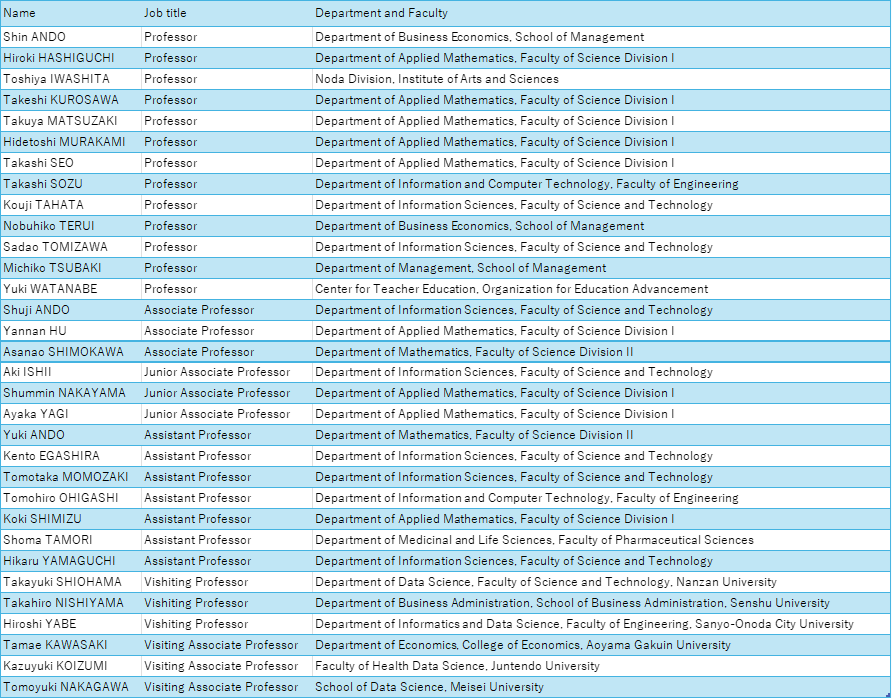
This research department is roughly divided into three groups that conducts research in the following fields.
1. Mathematical Statistics Basis Group
(Leader: Professor Hiroki Hashiguchi (Department of Applied Mathematics, Faculty of Science Division I))
The Multivariate Analysis Group includes faculty members from the Kagurazaka, Katsushika, and Noda campuses, as well as visiting professors and associate professors. Building on the current research themes of each member – such as multivariate missing data analysis, high-dimensional data analysis, random matrix theory, and dimension reduction methods – the group conducts research aimed at expanding into the Applied Statistics Research Group. The Statistical Model Group, composed of faculty from the Kagurazaka and Noda campuses, focuses on topics including statistical modeling and model selection, nonparametric methods, and contingency table analysis. The methods explored by the Mathematical Statistics Foundations Group are grounded in well-established theoretical principles and function as “white box” approaches – transparent and interpretable. In contrast, methods for solving real-world problems — such as heuristic techniques and deep learning – often resemble a “black box”, lacking interpretability.
A key challenge in building the theoretical foundation of data science is to bridge this gap: to illuminate the black-box nature of such solutions using the rigorous, transparent methodologies of mathematical statistics and related fields.
2. Applied Statistics Research Group
(Leader: Professor Takashi Sozu (Department of Information and Computer Technology, Faculty of Engineering))
In the field of medical statistics (biostatistics), faculty members based at the Katsushika Campus engage in research focusing on methodologies for study design and statistical analysis, with particular emphasis on medical and clinical research applications. In the domain of educational engineering, faculty members from the Kagurazaka Campus will lead research initiatives aimed at developing innovative educational methods and systems, grounded in quantitative analytical approaches. Furthermore, in recent years, there has been a notable increase in research activity across emerging interdisciplinary areas such as sports statistics, marketing analytics, and related fields. These efforts are being actively pursued, primarily by visiting professors and visiting associate professors. To further enhance these initiatives, the university plans to promote collaborative research projects that include student exchange programs, thereby fostering interdisciplinary engagement and academic mobility. In the area of statistical machine learning and mathematical optimization, faculty members at the Kagurazaka Campus undertake advanced research on the following themes:
– Natural language processing that integrates statistical and machine learning approaches with symbolic reasoning models
– Large-scale nonlinear optimization in the context of big data analytics and machine learning applications
– Statistical methodologies for computer-assisted data mining and pattern recognition
– Quantitative approaches in marketing science and business data science
These research activities are expected to contribute significantly to the advancement of foundational theory and applied methodologies in data-driven disciplines.
Deta Analysis Group
(Leader: Professor Kouji Tahata (Department of Information Sciences, Faculty of Science and Technology))
The Data Analysis Team is created to address the increasing need for precise and flexible analytical methods in today’s society, where a wide variety of complex data is generated and accumulated daily. The team aims to strengthen collaboration with external partners through the Data Science Center, which facilitates joint research with companies and research institutions. To achieve this, the team adopts a flexible structure that allows researchers with the appropriate expertise to be assembled according to the specific needs of each project.
While the Mathematical Statistics Group focuses on the theoretical development of statistical methods, and the Applied Statistics Group emphasizes practical applications in areas such as medicine, finance, education, and sports, the Data Analysis Team bridges the gap between theory and application. Its primary objective is to develop and apply statistically sound, interpretable methods to analyze complex real-world data.
The team actively engages in cross-disciplinary challenges, utilizing advanced techniques such as statistical modeling in big data environments, interpreting machine learning and deep learning results, causal inference, Bayesian estimation, and data visualization. Researchers from various campuses and departments collaborate to form optimal project teams, providing a high degree of flexibility to meet diverse research needs.
Building on Tokyo University of Science’s long-standing strength in mathematical statistics, the Data Analysis Team aspires to become a central hub for exploring the role of statistical analysis in supporting scientific decision-making amid real-world complexities.